
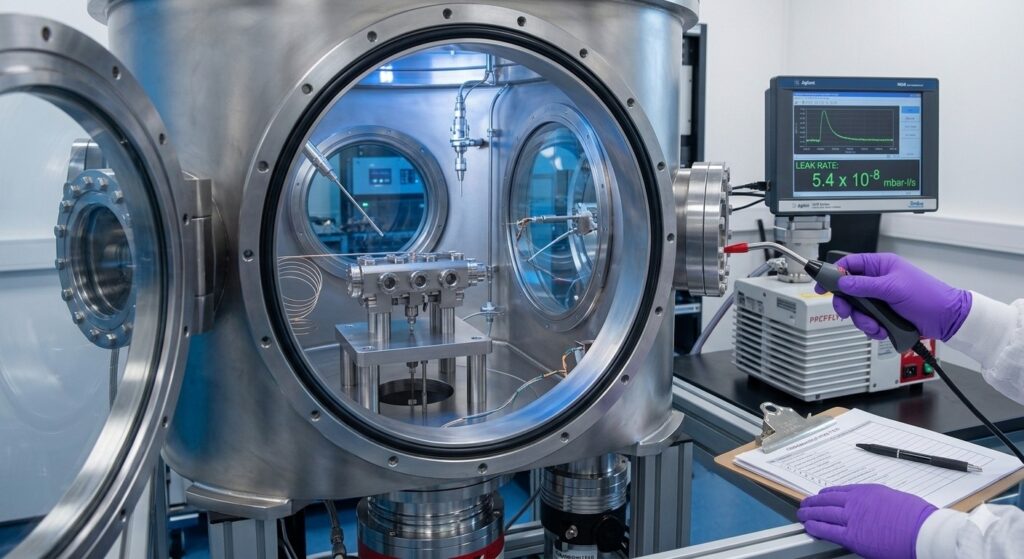
Aerocure Vacuum Technologies provides professional, ISO-certified helium leak testing services across India to protect your critical industrial systems from catastrophic failure. Our advanced helium leak testing solutions detect microscopic leaks with unmatched sensitivity and precision. We help industries meet stringent quality, safety, and compliance standards, ensuring your vacuum systems operate at peak efficiency.
Helium leak testing is a highly sensitive, non-destructive testing method used to detect and locate leaks in sealed components, systems, and vacuum chamber. The process uses helium gas as a tracer because it is inert, non-toxic, non-flammable, and has very small atoms that can easily pass through tiny leaks. A helium leak detector identifies and measures the amount of helium escaping or entering the test object, allowing even microscopic leaks to be detected with exceptional accuracy.
Aerocure Vacuum Technologies (AVT) provides professional helium leak testing services across all major cities in India, supporting industries with reliable and high-precision leak detection solutions. Our experienced engineers offer both on-site and in-house testing services, ensuring minimal downtime and maximum operational efficiency.
We provide comprehensive helium leak testing for:
- Vacuum Chambers & Process Vessels
- Gas Distribution Panels & Manifolds
- Hermetic Seals & Electronic Packages
- Heat Exchangers & Condenser Tubes
- Automotive Fuel & Air Conditioning Components
- custom vacuum assemblies
With nationwide service coverage, advanced helium leak detection equipment, and a team of experienced engineers, AVT is your trusted partner for high-quality helium leak testing anywhere in India.
Why Choose AVT for Helium Leak Testing?
At Aerocure Vacuum Technologies (AVT), we combine advanced leak detection equipment with experienced engineers to deliver accurate, reliable, and efficient helium leak testing services. Whether you require leak testing for vacuum chambers, industrial equipment, or critical process systems, AVT offers both in-house and on-site testing solutions tailored to your operational requirements. Our goal is to help customers achieve leak-free systems, improve process reliability, and maintain the highest standards of quality and performance.
Types of Helium Leak Testing Method We Offer
1. Evacuation Method Testing:
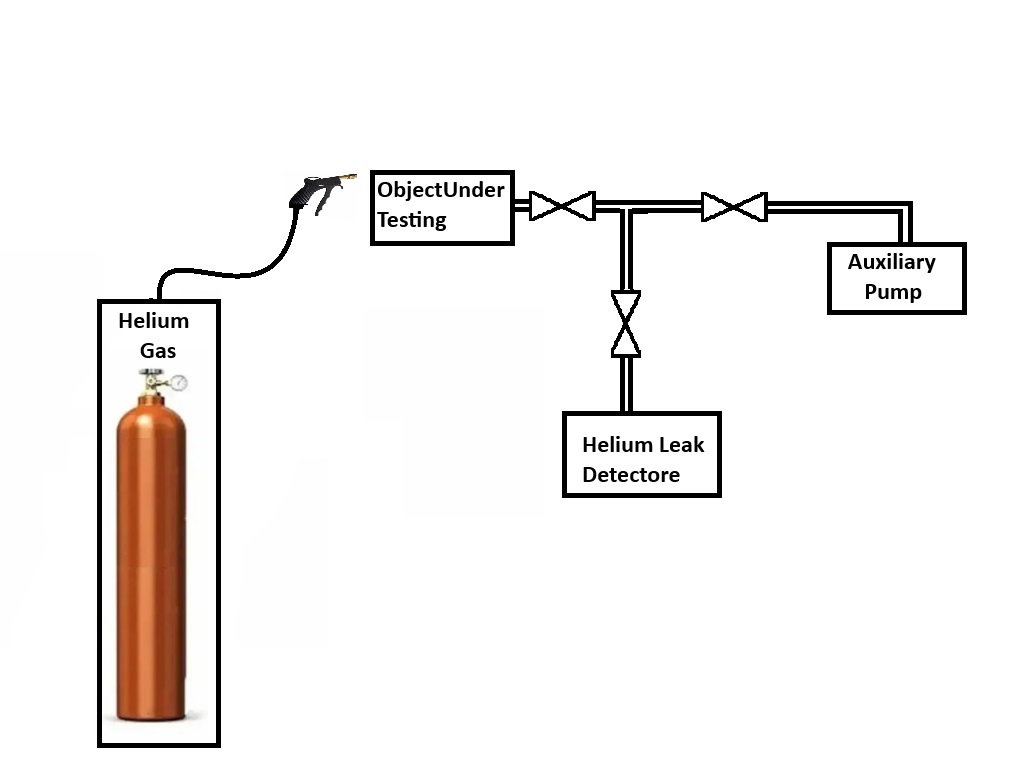
- To Detect Helium Coming Inside The Test Object By Spraying Helium With A Spray Gun After Evacuating The Inside Of The Test Object.
- Suitable For Finding A Small Leak Point, Applying To Finding A Relatively Small Leak. If Quantification Of The Total Leakage Of The Test Object Is Required, A Hood Method Is More Suitable.
- The Tracer Probe Test Can For Example Be Used On Seals, Flange Connections, Bellows, Weld Seams Etc.
2. Evacuation hood method test:
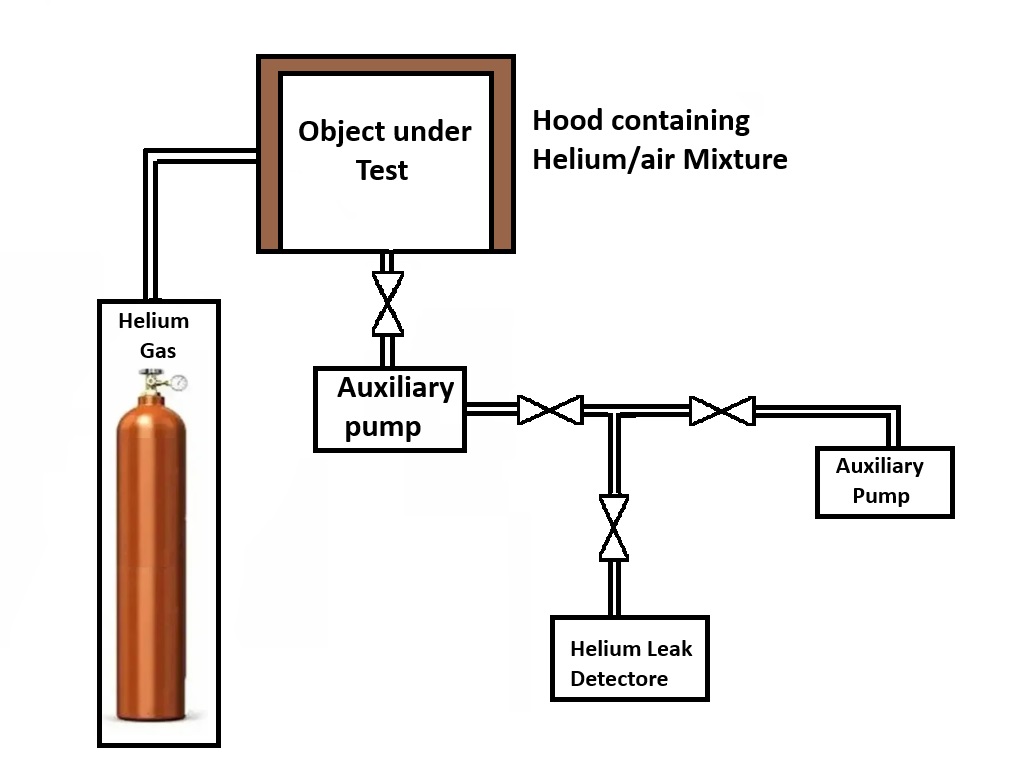
- To Detect Helium Coming Inside The Test Object After Evacuating The Inside Of The Test Object, Hooding The Outside Of The Test Object And Filling Helium Gas In The Hood.
- It Can Possible To Find The Total Leakage Of The Test Object That Can Be Evacuated, But Impossible To Find A Leak Point. If Finding A Leak Point Is Required, The Spray Method Is Suitable.
- The Evacuation Hood Test Method Can Example For The Aluminum Castings And Other Auto Mobile Components.
3. Over pressure hood test method:
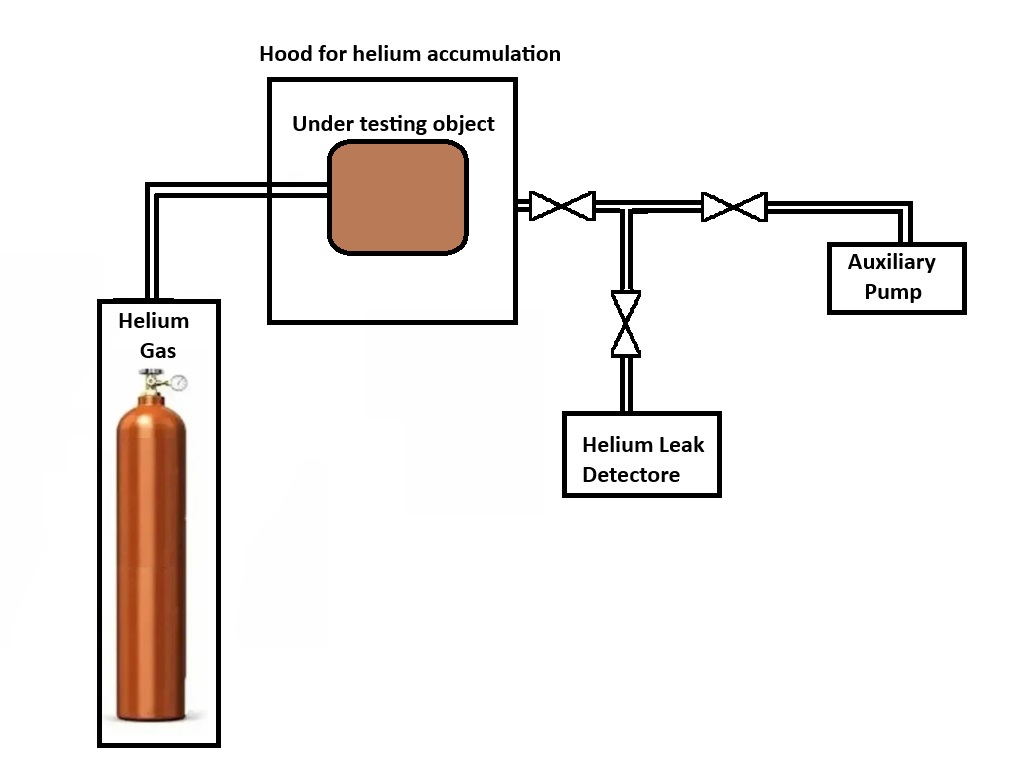
Similar to the vacuum hood method, the over pressure hood test provides a comprehensive, overall leak evaluation. This configuration utilizes a setup comparable to a standard vacuum test. A vacuum chamber serves as the hood, which is evacuated by an auxiliary pump and directly connected to the leak detector. Any helium tracer gas escaping through a leak in the test object is instantly quantified by the leak detector. Because helium mass spectrometer can identify extremely minute leak rates, this method is ideal for fully automated leak testing systems.
4. Helium Bombing Testing:
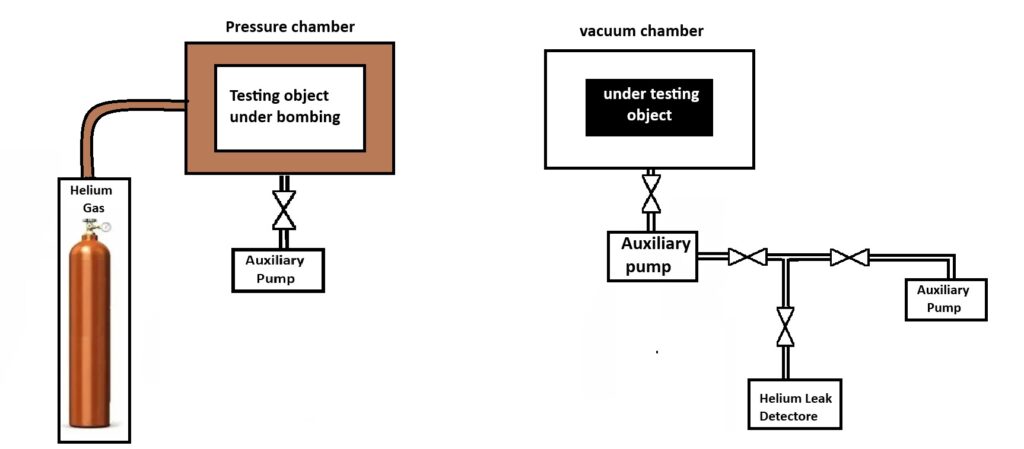
In manufacturing, ensuring the integrity of hermetically sealed components is critical. Even the smallest leaks can cause catastrophic field failures, especially in high-reliability applications. One of the most effective and sensitive methods for detecting these microscopic defects is helium bombing.
What is Helium Bombing?
Helium bombing is a fine-leak testing method where sealed components are placed inside a pressurized chamber and exposed to high-pressure helium gas. If a component has a micro-leak, the pressure forces the helium tracer gas inside its sealed cavity. Once removed from the bombing chamber, the part is transferred to a Helium Mass Spectrometer Leak Detector (MSLD) to measure the escape rate of the trapped gas. This precise process enables manufacturers to identify minute defects before they compromise component performance.
5. Sniffer testing:
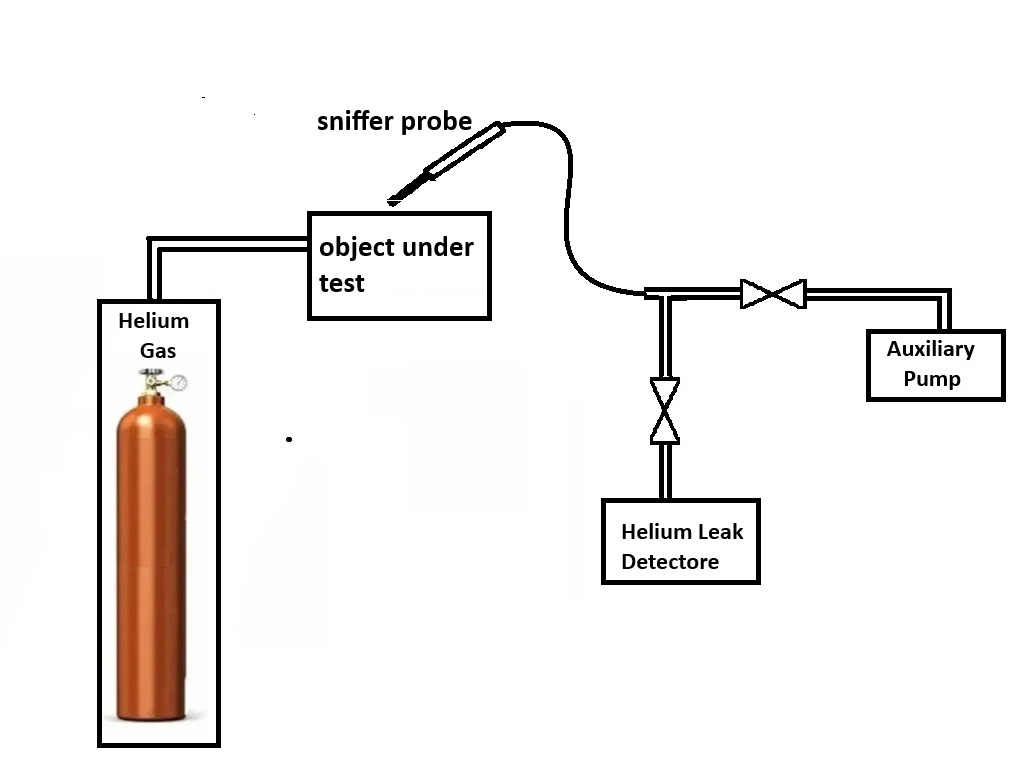
Sniff Leak Testing, often called a sniffer test, is a highly effective tracer gas detection method used to locate and pinpoint the exact source of a leak. During the testing process, the component is first evacuated and then pressurized with a tracer gas, typically helium. An operator then manually guides a specialized sniffer probe over the part’s surface and weld seams. The probe continuously samples the surrounding air, pulling it into a mass spectrometer to detect any escaping tracer gas. This method is exceptionally reliable for isolating micro-leaks and is perfectly suited for operator-dependent assembly, manual testing, and component rebuilding processes.
Industries We Serve
- Semiconductor Manufacturing
- Aerospace & Defense
- Pharmaceutical & Biotechnology
- Research Laboratories
- Vacuum Coating Industry
- Electronics Manufacturing
- Automotive Industry
- Medical Device Manufacturing
- Food Processing & Packaging
- Universities & Scientific Institutions